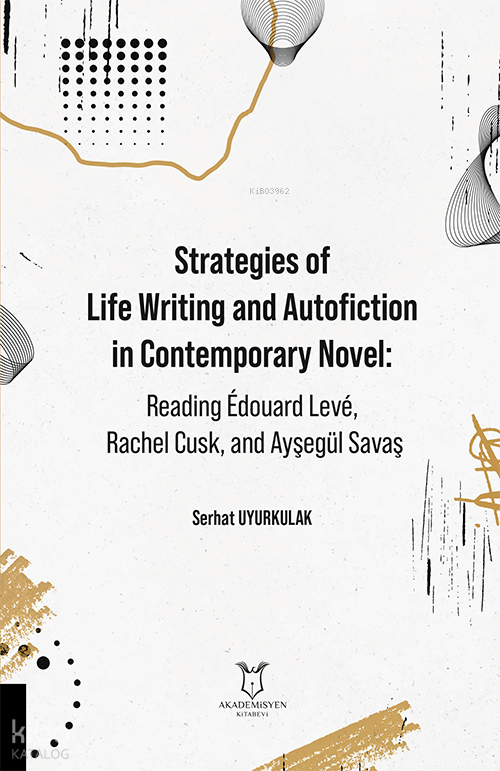
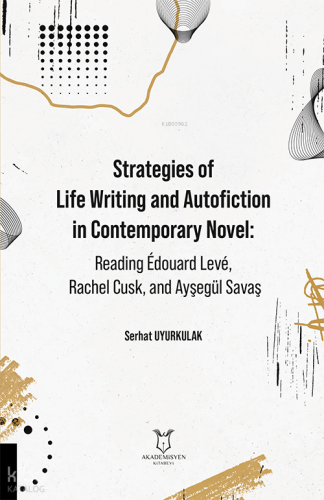
Strategies of Life Writing and Autofiction in Contemporary Novel;Reading Édouard Levé, Rachel Cusk, and Ayşegül Savaş
Boyut:
135-210-
Sayfa Sayısı:
164
Baskı:
1
Basım Tarihi:
2025-09-08
Kapak Türü:
Karton
Kağıt Türü:
Kitap Kağıdı
Dili:
İngilizce
Kategori:
%7
indirimli
343,75
319,69
Havale/EFT ile:
271,74
9786253755874
605016
https://www.kitapova.com/strategies-of-life-writing-and-autofiction-in-contemporary-novel-reading-edouard-leve-rachel-cusk-and-aysegul-savas
Strategies of Life Writing and Autofiction in Contemporary Novel;Reading Édouard Levé, Rachel Cusk, and Ayşegül Savaş
319.69
By combining close textual analysis with theoretical investigation, this book maps the formal and thematic shifts in life writing and autofiction in the twenty-first century. Through a focus on the work of Édouard Levé, Rachel Cusk, and Ayşegül Savaş, it shows how contemporary writers challenge dominant paradigms of selfwriting, replacing the search for a stable and coherent identity with narrative strategies marked by fragmentation, discontinuity, and non-linearity. This book will be of interest to scholars and students working on contemporary literature, life writing, and narrative theory, as well as general readers interested in the development of autobiographical narrative.
Contents
Chapter 1 Introduction:
The Changing Scene of Life Writing and Autofiction
1.1. A Brief Survey of the Emergence and Expansion of Life Writing
1.2. Twentieth-Century Theories of Life Writing
1.3. Autofiction as a Hybrid Genre of Postmodernity
Chapter 2 Writing the Self Otherwise:
Autofictional Experiments in Édouard Levé's Autoportrait and Suicide
2.1. Fragment as Self-Portrait, Flatness as Style
2.2. Database Logic and the Temporalities of the Self
2.3. Absence, Omission, and the Ethics of Self-Disclosure
2.4. From Autoportrait to Suicide: The Photographic Gaze and Textual Haunting
Chapter 3 Contouring the Self:
Rachel Cusk's Outline as a Relational Autobiography
3.1. The Elusive Self: A Life Written Through Others' Stories
3.2. Spaces of Encounter, Gender, and Voice
3.3. Relationality and Subjective Truth Across the Trilogy
3.4. The Outline Trilogy and Contemporary Life Writing
Chapter 4 The “Infraordinary” Self:
Ayşegül Savaş's Walking on the Ceiling as Autofiction
4.1. The Poetics of Withdrawal and the Articulation of Absence
4.2. Literary Interlocution and the Self-Conscious Narrative
4.3. Political Silence and the Infraordinary
4.4. Autofiction and the Unseen in White on White
Chapter 5 Conclusion:
Delineating the Contemporary Self
By combining close textual analysis with theoretical investigation, this book maps the formal and thematic shifts in life writing and autofiction in the twenty-first century. Through a focus on the work of Édouard Levé, Rachel Cusk, and Ayşegül Savaş, it shows how contemporary writers challenge dominant paradigms of selfwriting, replacing the search for a stable and coherent identity with narrative strategies marked by fragmentation, discontinuity, and non-linearity. This book will be of interest to scholars and students working on contemporary literature, life writing, and narrative theory, as well as general readers interested in the development of autobiographical narrative.
Contents
Chapter 1 Introduction:
The Changing Scene of Life Writing and Autofiction
1.1. A Brief Survey of the Emergence and Expansion of Life Writing
1.2. Twentieth-Century Theories of Life Writing
1.3. Autofiction as a Hybrid Genre of Postmodernity
Chapter 2 Writing the Self Otherwise:
Autofictional Experiments in Édouard Levé's Autoportrait and Suicide
2.1. Fragment as Self-Portrait, Flatness as Style
2.2. Database Logic and the Temporalities of the Self
2.3. Absence, Omission, and the Ethics of Self-Disclosure
2.4. From Autoportrait to Suicide: The Photographic Gaze and Textual Haunting
Chapter 3 Contouring the Self:
Rachel Cusk's Outline as a Relational Autobiography
3.1. The Elusive Self: A Life Written Through Others' Stories
3.2. Spaces of Encounter, Gender, and Voice
3.3. Relationality and Subjective Truth Across the Trilogy
3.4. The Outline Trilogy and Contemporary Life Writing
Chapter 4 The “Infraordinary” Self:
Ayşegül Savaş's Walking on the Ceiling as Autofiction
4.1. The Poetics of Withdrawal and the Articulation of Absence
4.2. Literary Interlocution and the Self-Conscious Narrative
4.3. Political Silence and the Infraordinary
4.4. Autofiction and the Unseen in White on White
Chapter 5 Conclusion:
Delineating the Contemporary Self
Yorum yaz
Bu kitabı henüz kimse eleştirmemiş.
-
-%37
 Stokta yok

-
Yeni-%7
Stokta yok
-
Yeni-%7
Stokta yok%7İNDİRİM1.250,00 1.162,50
-
Yeni-%7
Stokta yok
-
Yeni-%7
Stokta yok
-
Yeni-%7
Stokta yok%7İNDİRİM350,00 325,50
-
-%7
Stokta yok%7İNDİRİM1.100,00 1.023,00
-
-%7
Stokta yok
-
-%7
Stokta yok%7İNDİRİM900,00 837,00
-
-%7
Stokta yok
-
-%7
Stokta yok